The DiFX correlator
This document is centered around the NRAO installation of the [difx] software correlator and its supporting software. Much of the contents here applies to other installations of DiFX as well, but keep in mind that not a lot of effort is made to generalize these instructions. Fig. 1 shows the general data flow-path within the DiFX software correlator system.
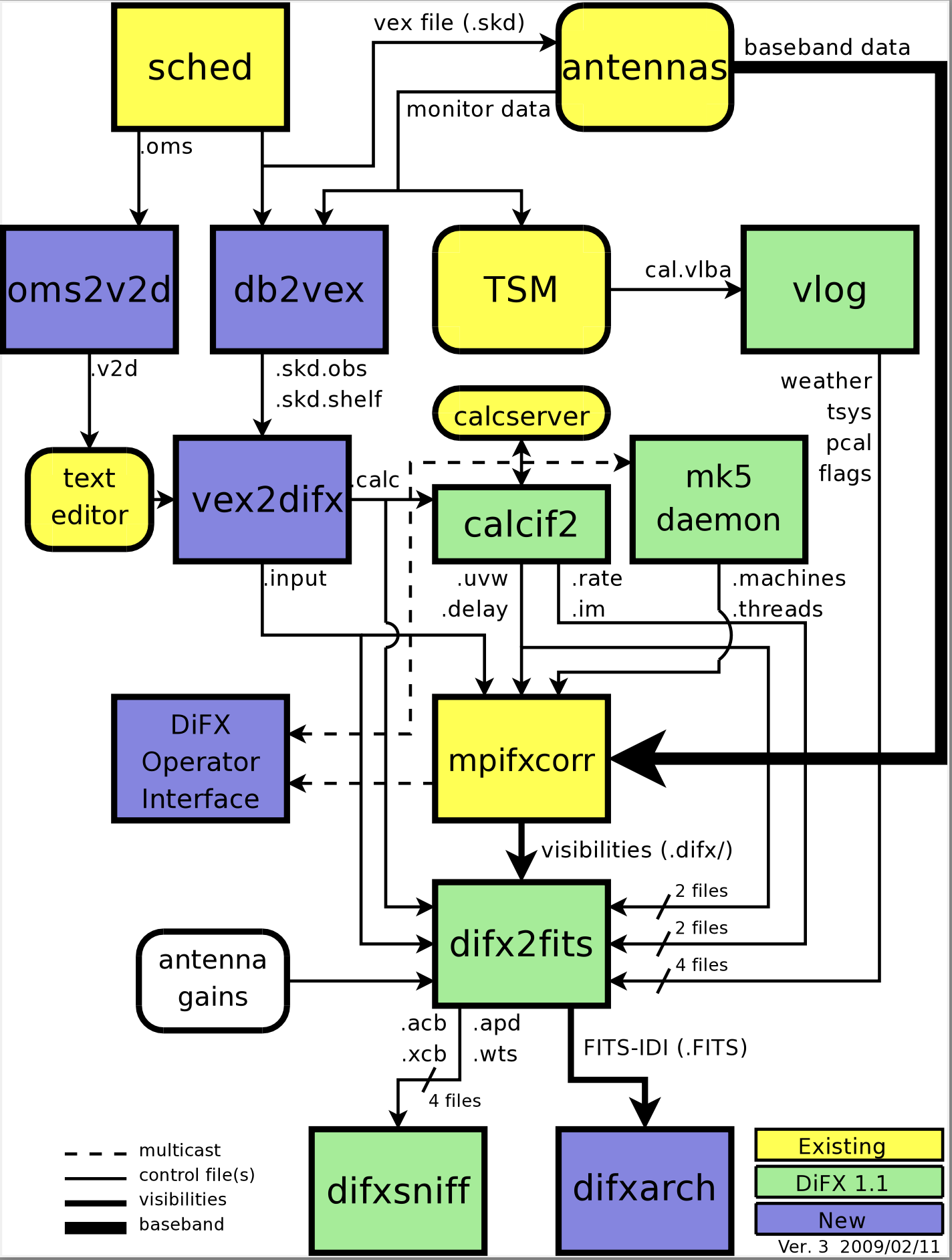
Fig. 1 The DiFX software correlator block diagram as implemented for the VLBA.
Past, present, and future versions of DiFX as packaged and used by VLBA operations are described in the following subsections.
NRAO-DiFX 1.0
Versions 1.0 and 1.1 based correlation on the VLBA hardware correlator
job scripts – the .fx files. This ensures a compatibility period
during which both correlators can produce visibilities with expectations
of functionally identical results, a feature critical for validation.
This strategy also minimizes the required software effort at its
earliest phases. Version 1.0 came with the following features:
A complete path from
.fxjob scripts to.FITSfilesA command-line only interface
Documentation (you are reading it now)
Support for VLBA and Mark IV formats
Correlation directly off Mark5 modules
Support for all projects types except those using special modes, such as pulsars, space VLBI, and near field objects
Spectral and time resolution bounded only by practicality
While this version should handle most observations, fast frequency switching and geodesy experiments will produce a large number of output FITS files which may be annoying to observers and the archive. Version 1.0 was available on February 6, 2008.
NRAO-DiFX 1.1
Version 1.1 builds on version 1.0 and adds the following features:
Used version of
mpifxcorrthat has gone through code merge with the official versionBlanking of data replaced by headers (Mark4 format only)
Proper data weights
Initial Mark5B support
Support for oversampled data through decimation
Multicast status information for GUI interface
Correlation of moving and near field objects
Concatenation of multiple output files into a single or multiple FITS-IDI file(s)
Better support for jobs with multiple configuration tables
Playback off Mark5 modules with missing disks
Support for Amazon based Mark5 units
Completely replaced the “Makefile” system with better integrated alternative
Generation of delay model polynomials rather than tables, more like VLBA HW correlator
\(u, v, w\) values are derived from the delay model (and hence include corrections for aberration, near field observations, and other subtle effects) and are evaluated when writing the FITS file
DiFX version accountability
Validation of data frames prior to decoding
Data evaluation (“sniffing”) built into FITS converter
This version was released on September 3, 2008.
Bugs fixed
Here are listed some of the more important bug fixes:
The clock offset was used with the wrong sign in the IM table.
Printed precision of some important numbers (RA and Dec) was increased.
Autocorrelations were ordered incorrectly for observations with a single polarization.
The Mark4 format decoder had a 1 day off bug.
The Mark4 format decoder had a 64\(\times\)fanout sample timing offset.
Several causes of crashes were fixed; no known crashes remain.
Missing VLBA monitor data was handled badly.
Due to OpenMPI peculiarity, some processing nodes would get most or all of the work in some cases, which cause the work being done on other nodes to be ignored. This was fixed by looking for results in a round-robin manner.
Integrations that contain data from two adjacent scans are stripped when writing FITS files.
Allow FITS files larger than 2GiB in size.
Known problems
Known bugs as of the NRAO-DiFX 1.1 release:
The last couple (typically 2) integrations of a job (not a scan) tend to have low weight due to a premature termination of data processing.
DiFX 1.5.0
With DiFX 1.5.0 comes a name change. Past releases of this series have
been known as “NRAO-DiFX”. The DiFX community has been largely receptive
to the NRAO additions in support of mpifxcorr and it was decided
that dropping the “NRAO” was appropriate. In some cases the term “VLBA
DiFX” or “VLBA DiFX 1.5” may be mentioned. These are simply the
deployment of DiFX 1.5.0 for the VLBA correlator with some VLBA specific
features. Note that the name given to the VLBA deployment of DiFX is
formally “VLBA DiFX”.
Version 1.5.0 will start allowing correlation of experiments that cannot
be represented by .fx files and will be based on vex files. Version
1.5.0 builds on version 1.1 and adds the following features:
Support for using a wide variety of vex files as the basis for correlation.
Native ephemeris-based object trajectories are supported.
Pulsar gating is supported.
Pulsar binning is supported, but not cleanly yet.
A graphical user interface is available for correlator operators.
The multicast system is fully implemented and is used monitor and control correlation and other operations.
Mark5B formatted data, including its 2048 Mbps extension, is supported.
The VLBA DiFX Operations Plan [opsplan] is implemented, including interface to the VLBA archive.
Non-NRAO users of DiFX 1.5.0 will still be able to use the tools provided but may not be able to take full advantage of the database back-end without some customization; it is the aim of this document to point out cases where the database is required. Many of the programs described in previous versions of this document will be upgraded or overtaken by more capable replacements.
Release of DiFX 1.5.0 was announced on June 25, 2009.
Bugs fixed
Here are listed some of the more important bug fixes:
A rounding issue in
mpifxcorroccasionally caused the wrong source’s UVWs to be assigned.Lower side band data would come out of the sniffer portion of
difx2fitswith the wrong sign for phase, rate, and delay.Different rounding was used to generate start times for
.inputand.calcfiles. There are no severe consequences of this issue.Scaling in pulsar gating has been made more sane.
DiFX 1.5.1
DiFX 1.5.1 is mostly a bug fix update to version 1.5.0, but with a few new features. The new features include:
Option to force job breaks (with the break parameter) has been added to
vex2difxTime/date formats other than decimal MJD are now accepted by
vex2difxSpecification of data files to correlate (rather than Mark5 units) is supported in
vex2difxSpecification of network parameters in
vex2difxto allow correlation of eVLBI projectsdifx2fitsproduces a new output file with suffix.jobmatrixprovides the user with a better idea of the mapping of jobs into.FITSfilesA
vex2difxmode for generating DiFX files useful for determining pulsar phase has been addedEOP values can now be provided within the
.v2dfileUpcoming FITS-IDI keyword WEIGHTYP populated
Zero-weight data is not written from
mpifxcorrNew utility
checkdirto look for oddities in Mark5 module directory files
Bugs fixed
Here are listed some of the more important bug fixes:
Concatenation of jobs in the creation of
.FITSfiles does the right thing for cases where the antenna subsets change and where antenna reordering is done.The Pulsar Gate Model (GM)
.FITSfile table is now correctly populated for pulsar observations.Autocorrelations are written for each pulsar bin
The FXCORR simulator mode of
vex2difxnow selects the correct reference time for antenna clock offsets.A work-around for a Streamstor problem has been added that should improve reliability in Mark5 module correlation when a change in bank is needed.
The sign of clock offsets in vex files has been reversed to follow the vex standard
Jobs are split at leap seconds
LBA data formats are handled more correctly in
vex2difxThe model generator (
calcif2) now respects polynomial parameters interval and order given on the command line.
DiFX 1.5.1 was made available via subversion on Sep 8, 2009.
DiFX 1.5.2
DiFX 1.5.2 is mostly a bug fix update to version 1.5.1, but with a few new features. This version of DiFX comes with the following components (and versions): calcif2 (1.1), calcserver (1.2), difx_db (1.12; NRAO-only), difx2fits (2.6.1), difx2profile (0.1), difxio (2.12.1), difxmessage (0.7), mark5access (1.3.3), mk5daemon (1.2), mpifxcorr (1.5.2), vex2difx (1.0.2), and vis2screen (0.1). The new features include:
Support unmodulated VLBA format data with new pseudo-format “VLBN”
mpifxcorrnow warns when difxmessage is in use so the user knows why no messages appear on the screenNew utility
difxcalculatorin thedifxiopackageeVLBI support within
vex2difxVastly improved real-time correlation monitoring
New utility
diffDiFX.pyto compare two DiFX output filesImproved and more consistent error messages (and some of them are now documented!)
vex2difxnow operates in strict parsing mode by defaultAdditional user feedback to indicate suspicious or bad
.polycoand.v2dfilescalcif2warns if any NaNs or Infs are producedClock adjustments are easier now with deltaClock and deltaClockRate parameters in the
vex2difxantenna settings
Bugs fixed
Improve timestamp precision (thanks to John Morgan)
The
vlogprogram (used at NRAO only, I think) misparsed the pulse cal information in some casesFixed memory leak in
difx2fitswhen combining a large number of jobsImproved FXCORR simulation mode in
vex2difxMark5 directory reading systematically generates unique names for all scans even when two scans have the same name
Improve reporting of Mark5 errors during playback and change alert severity to be more appropriate
Don’t overblank certain Mark4 modes (thanks to Sergei Pogrebenko for the bug report)
Vex ‘data valid’ period now properly respected
Vex clock table tolerance issue corrected
Changes in Mark5 mode should be safer (note that currently
vex2difxnever exercises multiple modes in a single job)When making the cross spectrum sniffer plots, respect the reference antenna
Improved pulsar polynomial file error checking is performed
Amplitude-phase-delay (APD) sniffer plots always have refant first when multiple refants are supplied
Project name should now appear on sniffer APD plots
Mark5 units now send status information even when no playback is occuring (eliminating the incorrect
LOSTstate issue as displayed in the DOI)
Known problems
Extensive use in VLBA operations has shown that occasional data dropouts of one or more antenna, sometimes in a quasi-repeatable manner, affect completeness of some jobs. It is not clear exactly what the cause is at this point, however its cure is a high priority.
Loss of a few FFTs of data will occur in rare circumstances.
Clock accountability is poor when jobs containing multiple clock models for antennas are combined.
DiFX 1.5.2 was made available via subversion on Jan 20, 2010.
DiFX 1.5.3
DiFX 1.5.3 is mainly intended as a bug fix update to version 1.5.2, though some new features have made their way into the codebase. This version of DiFX comes with the following components (and versions): calcif2 (1.3), calcserver (1.3), difx_db (1.13; NRAO-only), difx2fits (2.6.2), difx2profile (0.2), difxio (2.12.2), difxmessage (7.2), mark5access (1.3.4), mk5daemon (1.3), mpifxcorr (1.5.3), vex2difx (1.0.3), and vis2screen (0.2). Many changes are motivated by issues found running DiFX full time in Socorro.
The new features include:
Mark5 directory (
.dir) files can containRTon the top line to indicate the need to play back using Real-Time mode.difxqueue(NRAO only) now takes an optional parameter specifying the staging area to use.New Mark5 diagnostic programs (
vsnandtestmod) introduced to wean off the use of theMark5Aprogram.mk5daemoncan now mount and dismount USB and eSATA disks through mk5commands.mk5cpnow makes the destination directory if it doesn’t exist.mk5daemonwill now warn if free disk space is getting low.db2vex(NRAO only) now allows field station logs to be provided. As of now, only media VSNs are extracted.Playback off Mark5 units has been made more robust with better error reporting.
New utility
m5foldthat can be used to look at repeating signals in baseband data total power (e.g., switched power)vex2difxnow supports job generation in cases where upper side band was observed at one antenna and lower sideband at another.
Bugs fixed
Don’t unnecessarily drop any FFTs of data.
Sub-integrations longer than one second could cause integer overflows.
Fix bug in
vex2difxwhere jobs were not split at clock breaks.difx2fitswas guilty of incorrect clock accoutability after a clock change at a station when merging multiple jobs. Worked around by not allowing such jobs to merge.db2vex(NRAO only) warns when more than one clock value is found for an antenna.Mark5 unit bank switches now routinely call
XLRGetDirectory()to work around a newly discovered bug in the StreamStor software.A couple possible memory leaks in the mark5access library were fixed (thanks Alexander Neidhardt and Martin Ettl).
Lots of compiler warnings quashed (mostly of the “unused return value” kind).
Olaf Wuchnitz found two FITS file writing problems in
difx2fitsdating back to code inherited from FXCORR!Two more digits are retained for the time and one more digit is retained for amplitude information in the
.apdand.apcsniffer files.Some bugs related to replacement of special characters by “entities” in XML messages are fixed.
New traps are in place in many places to catch string overruns.
Fix for writing
.calcfiles with more than one ephemeris driven object.vex2difxwould get very slow due to constantly sorting a list of events. Now this list is only sorted when necessary, drastically speeding it up.The
RCfreqIdparameter in the difxdatastream structure (in difxio) was used with two different meanings that are normally the same. Cases where they differred caused exceptions. Fixed in difxio and difx2fits. (Thanks to Randall Wayth for leading to the discovery)difx2fitswould assign a bogus.jobmatrixfilename when not running the sniffer.vex2difxcould get caught in an infinite loop when making jobs where two disk modules had zero time gap.difx2fitsused a bad config index when making the puslar GM table when multiple configs were present.Within
mpifxcorran extra second was added to the validity period for polycos to ensure no gap in coverage.mk5dirwould add correct the date improperly for Mark4 formats after beginning of 2010.Lots of fixes for building FITS files out of a subset of baseband recorded channels.
FITS files now support antennas with differing numbers of quantization bits.
Lots of Mac OS/X build issues fixed.
DiFX 1.5.3 was released on April 16, 2010.
DiFX 1.5.4
DiFX 1.5.4 is likely the last 1.5 series formal release of DiFX, though an additional release could be made if demand is there.
The new features include:
difx2fitscan now produce FITS files with only a subset of the correlated sub-bands.difx2fitscan be instructed to sniff on an arbitrary timescale.The
makefitswrapper fordifx2fitsnow respects a -B option for phase bin selection.difxiohas improved checking that prevents merging of jobs with incompatible clocks.difxionow maintains a separate clockEpoch parameter for each antenna.difxStartMessagenow contains DiFX version to run, allowing queued jobs to be run under different DiFX versions.The curses utilities
mk5monandcpumonnow catch exceptions and can be resized without infecting the terminals they are run in.New sub-library called mark5ipc added that provides a semaphore lock for Mark5 units.
The
testdifxmessagereceiveutility can now filter on message types.Support for SDK9 throughout (e.g., in tt mpifxcorr,
mk5daemon, and other utilites).Support for new Mark5 module directory formats (Haystack Mark5 memo 81).
Several new Mark5 utilities to make up for Mark5A functionality that will not longer be available:
vsn,testmod,recover,m5erase.mk5cpcan now copy data based on byte range.Many programs directly talking to the StreamStor card of Mark5 units use WATCHDOG macros for improved diagnostics when problems occur.
More protection against incomplete polyco files added to
mpifxcorr(Note: should add this tovex2difxas well).The GUI can now spawn different DiFX versions at will through the use of difxVersion parameter in the DifxStartMessage and wrapper scripts.
difx2fitscan now convert LSB to USB for matching purposed. When used, all LSB sub-bands must have corresponding USB sub-bands on one or more other antenna.mark5access-based utilities (e.g.,mp5spec) can now read from stdin.New utility
mk5catcan send data on a Mark5 module to stdout.
Bugs fixed
Only alt-az telescopes received the correct model. Fixed. Note that CALC and FITS-IDI don’t have a good match between their sets of allowed mount types.
difx2fitsnow properly propagates quantization bits on a per antenna basis.Logic errors in
difxiowould confusedifx2fitsin cases where different antennas use different frequency setups. Fixed.Weights are blanked in
difx2fitsprior to populating each record, preventing screwy weights for unused sub-bands.vex2difxwould sometimes hang or not converge on job generation. Fixed.vex2difxnow doesn’t assume source name is same as vex source def identifier.mpifxcorrgenerated corrupted weights and amplitudes when post-FFT fringe rotation was done. Fixed.
Known bugs
Tweak Integration Time feature of
vex2difxoften does the wrong thing.
DiFX 1.5.4 was released on October 12, 2010.
DiFX 2.0.0
DiFX 2.0.0 is based on an upgraded mpifxcorr that breaks .input
file compatibility with the 1.0 series. This new version will allow more
flexible correlation of mis-matched bands and correlation at multiple
phase centers along with general performance improvements. Development
of the 2.0 capabilities will occur in parallel with the 1.0 series
features.
New features
Pulse cal extraction in
mpifxcorr.Massive multi-phase center capabilitiy.
New utitility
zerocorradded.External pulse cal extraction utility
m5pcaladded.DiFX output format is all-binary, meaning speed and disk savings
Known bugs
Zoom band support has multiple problems.
DiFX 2.0.0 was released on October 12, 2010.
DiFX 2.0.1
DiFX 2.0.1 is a bug fix and clean-up version in response to numerous improvements to DiFX 2.0.0. There are a number of new features as well.
New features
New utility
checkmpifxcorrto validate DiFX input filesSwitched power detection in
mpifxcorrEarly multi-thread VDIF format support
RedHat RPM file generation for some packages (can extend to others on request)
Improvements to method of selecting which pulse cal tones get propagated to FITS
Initial complex sampling support
Improved locking mechanism for direct mark5 access (using IPC semaphores; difxmessage)
Bug fixes
Fix model accountability bug in difx2fits when combining jobs
Numerous fixes for zoom bands (in
mpifxcorr,vex2difx&difx2fits)Native Mark5 has improved stability for cranky modules
Numerous fixes for DiFX-based phase cal extraction (mostly in
difx2fits, mostly for multi-job)Fractional bit correction for a portion of lower sideband data got broken in difx 2.0.0. Fixed.
Migrate
difxcalculatorto DiFX 2; was not complete for DiFX 2.0.0
DiFX 2.0.1 was released on June 24, 2011.
DiFX 2.1
New features
Mark5-based correlation: easy access to S.M.A.R.T. data (can be viewed with getsmart)
Mark5-based correlation: emit multicast message containing drive statistics after each scan
VSIS interface added to mk5daemon
Support for non power-of-2 FFT lengths
New utilities:
mk5map(limited functionality),fileto5c,record5cRemote running of
vex2difxfrommk5daemonMultithread VDIF support enabled for the data sources FILE and MODULE, including stripping of non-VDIF packets
New features added to existing utilities:
mk5cp: copy without reference to a module directorymk5cp: ability to send data over ssh connectionvsn: get SMART data from disk drives
e-Control source code analysis (Martin Ettl, Wettzell)
Restart of correlation is now possible
difx2fits: -0 option to write minimal number of visibilities to FITSdifx2fits: write new RAOBS, DECOBS columns in source tabletweakIntTime option to
vex2difxhas been re-enableddiffDiFX.pycan now cope with two files that don’t have exactly the same visibilities (i.e., some visibilities are missing from one file)plotDiFX.pyandplotDynamicSpectrum.pynow have better plotting and more optionsNew FAKE datastream type for performance testing
Espresso, a lightweight system for managing disk-based correlation, has been added to the DiFX repository.
Option to correlate only one polarization has been added.
mk5dircan now produce.dirfile information for VDIF formatted data.Add NRAO’s sniffer plotters to the repository.
Bug fixes
LBA format data now scaled roughly correctly (removing the need for large ACCOR corrections).
There was a bug when xmaclength was \(>\) nfftchan for pulsar processing. This has been corrected.
guardns was incorrectly (overzealously) calculated in mpifxcorr.
Mk5DataStream::calculateControlParams: bufferindex>=bufferbytesbug fixed.Low weight reads could result in uninitialized memory; fixed.
Streamstor
XLRRead()bug work-around installed several places (read at position 0 before reading at position \(> 0\)). This is thought not to be needed with Conduant SDK 9.2 but the work-around has no performance impact.Fix to pulse calibration data ordering for LSB or reordered channels.
Pulse cal amplitude now divided by pulse cal averaging time in seconds.
Pulse cal system would cause crash if no tones in narrow channel. Fixed.
Zoom band support across mixed bandwidths (see caveat below).
Fix for spurious weights at end of jobs (untested…)
Mixed 1 and 2 bit data are handled more cleanly
mpifxcorr terminates correctly for all short jobs. Previously it hung for jobs with a number of subints between nCores and \(4 \times\) nCores
Correctly scale cross-correlation amplitudes for pulsar binning when using
TSYS\(>0\) (accounts for varying number of samples per bin c.f. nominal)Lower side-band pulse cal tones had sign error. Fixed.
DiFX 2.1 was released on May 25, 2012.
DiFX 2.1.1
DiFX 2.1.1 was a minor patch release to fix a scaling issue with autocorrelations of LBA-format data in mpifxcorr.
DiFX 2.1.1 was committed as a patch to DiFX 2.1 on June 7, 2012.
DiFX 2.2
New features
calcif2: ability to estimate delay polynomial interpolarion errorsSupport for a “label” identifier for a local version of DiFX that will help discriminate exact version used.
Faster Mark5 directory reading
Faster VDIF corner turning through customized bit shifting functions
mpifxcorrcan now be built without Intel Integrated Performance Primitives, though resulting in a slower correlator.vdifio: several new VDIF manipulation and processing utilities added:vmux,vsum,vdifd,vdifspec,vdiffold,vdifbstatedifxbuild: a new installation programdifxspeed: a program to benchmark and help optimize DiFX
Bug fixes
Mutex locking bugfix for very short jobs
Prevent MODE errors when a datastream runs out of data well before the end of a job
calcif2: fix azimuth polynomial generation in case of wrapFix for FITS file generation for mixed sideband correlation
difx2fitsnow uses appropriate gain tables for S and X band in S/X experiments (Thanks to James Miller-Jones for reporting)difx2fits: correct pcal, weather, tsys and flag data for observations crossing new yearFixed scaling of autocorrelations for LBA format data
0.5 ns wobble in delays for 2 Gbps Mark5B data fixed
Fix bug preventing subintegrations longer than 1 second. Now 2 seconds is allowed (this limit comes from signed integer number of nanoseconds).
Weights corrected in cases where two setups differening only by pcal setup were correlated against each other
Quashed data and weight echos that would occur for about 1 integration at the beginning of each scan for datstreams that ran out of data before end of job.
The multicast (diagnostic) weights were low or zero in case of frequency selection (zoom band or freqId selection). Fixed.
mark5access: fix (non)blocking issue when receiving data from stdin
DiFX 2.2 was released on June 12, 2013.
DiFX 2.3
New features
mpifxcorr: LO offsets are now corrected in the time domain when fringe rotation is also done in the time domain (the usual mode), allowing considerably larger LO offsets without decorrelation
mpifxcorr: Working polarization dependent delay and phase offsets
mpifxcorr: Experimental linear2circular conversion
mpifxcorr: Complex Double sideband (RDBE/Xcube) sampling support (Note: things are not perfect here; wait for 2.4 for real use)
mpifxcorr: new file/Mark5 based VDIF/Mark5b datastream (faster and more robust)
mpifxcorr: implement work-around for buggy kernel-driver combinations; Mark5 read sizes >20 MB now allowed
utilities: some new command line tools for Mark5B and VDIF files (vsum, mk5bsum, vmux, mk5bfix)
new options for passing calibration (Walter B: memo forthcoming)
Hops updated to version 3.9
Bug fixes
mpifxcorr: Datasteam buffer send size now calculated correctly for complex sampled data
mpifxcorr: Avoid very rare bug where combination of geometric delay and data commencing mid-subint meant one invalid FFT might be computed
mpifxcorr: multicast weights are now computed correctly for mixed-sideband correlation
mpifxcorr: fixed bug where some autocorrelations were not saved in a mixed-sideband correlation
mpifxcorr: fixed bug where send size could be computed incorrectly by 1-2 bytes for
Mark4/VLBA/Mark5B/VDIF formats, potentially resulting in very small amounts of data loss
DiFX 2.3 was released on January 18, 2014.
DiFX 2.4
New Features
mpifxcorr
Support a FAKE correlation mode for multi-threaded VDIF.
The mpifxcorr produced PCAL files have had a format change that allows unambiguous interpretation across all use cases.
Add network support (TCP, UDP and Raw Ethernet) for multi-threaded VDIF: 1. TCP and UDP variants not tested yet; 2. raw Ethernet variant is used for the VLITE project.
Support updated Mark5 module directories.
Better checking that Mark5 data being processed matches what is expected.
Improved Mark5B decoding: 1. Mark5B data streams are now filtered for extra or missing data; 2. packets with invalid bit (actually the TVG bit) set replace missing data; 3. this means any valid Mark5B data with the TVG bit set will not correlate.
Information about each Mark5 unit used in “native mode” is emitted at start of jobs so it can be logged.
Ultra-low frame rate VDIF data was affected by allowing a long “sort window” in the VDIF multiplexer. This has been reduced to 32 frames and seems to work fine for all bandwidths now.
difx2fits
Slightly improved compliance with the FITS-IDI convention: 1. invalid Tsys values become NaN, not 999; 2. populate
DELTATkeyword in ModelComps table.
difxio
Support for X/Y polarization correlation. Many fundamental issues with linear polarization remain though: 1. this does not support in a meaningful way Linear*Circular correlations; 2. there is a terminology gap in many bits of software and file formats that confuses X/Y with H/V polarization bases; 3. the intent of this support is for short baselines (VLITE).
mark5access
Support for “d2k” mode in Mark5B format (swapped sign and mag bits).
fixmark5b() function fixed for case that fill pattern is seen at the 1 second transition.
Make use of the TVG bit as an “invalid frame” indicator for Mark5B data.
m5bstate: support complex sampled data
mk5daemon
New utility mk5putdir: reads a binary file and replaces a Mark5 directory with it.
mk5dir: when reading the directories, saves a copy of the binary representation in case it is needed later (perhaps via mk5putdir)
Reworked mark5 module directory support, including support for many new variants of the directory format.
mk5erase will save a “conditioning report” to
$MARK5_CONDITION_PATHif that environment variable is set.
vdifio
Fairly large change to the API. Please read the ChangeLog for details.
vex2difx
Respect the record enable bit in the SCHED block. If that value is 0 no correlation will be attempted for that antenna.
Bug fixes preventing some LSB/zoom bands from being correlated.
Complex data type and number of bits are now read from vex file.
Bug fixes
A “jitter” of 0.5 ns when using 2Gbps Mark5B format was fixed. A fix was back-ported to DiFX 2.3.
A similar jitter was corrected for high frame rate VDIF (problem identified by the VLITE project)
Fix case of intermittant fringes that was due to incorrect assumption about the sizeof(unsigned long): 32 bits on a 32-bit system vs. 64 bits on a 64-bit system. Some other variable types were changed for long term type safety
Fix off-by-one in correlation using LSB and zoom bands together.
DiFX 2.5.1
New features
Innitial support for correlating Mark6. This is still much a work in progress.
Multiple datastreams per antenna supported via
vex2difxNew delay model program: difxcalc11.? No longer requires calcserver.
Support for more than 6 days of EOP values.
“Union mode” in difx2fits allows merging of correlation output that uses different setups. Some restrictions apply. Designed for GMVA and RadioAstron use.
Improved VDIF support: wider range of bits/threads, support for multi-channel, multi-thread VDIF, support for complex multi-thread VDIF
Support for new VDIF Extended Data Version 4 which is useful for multiplexed VDIF data. See: http://vlbi.org/vdif/docs/edv4description.pdf
Python bindings for vdifio and mark5access
mpifxcorr: per-thread weights implemented
Automatic selection of arraystride by mpifxcorr if set to zero; this is done per-datastream.? Very useful for correlation of ALMA data or others with non-standard sample rates.
Automatic selection of xmacstride by mpifxcorr if set to zero
Automatic selection of guardns by mpifxcorr if set to zero
mpifxcorr can now operate with unicast messages instead of multicast. Useful in some situations where multicast is not supported.
New “dirlist” module/file directory listing format.
mk5cpappend mode to resume interrupted copyALMA support in HOPS: non-power-of-two FFTs, up to 64 freq. channels, full linear/circular/mixed polarization support
HOPS improvemetns for VGOS through improved manual phase cal support
New package: polconvert. Used to post-correlation convert from linear to circular polariations
New package: autozoom. Helps a user develop
.v2dfile content when setting up complicated zoom band configurations.New package: datasim: generate baseband data suitable for simulated correlation
Improved error reporting in many places
Bug fixes
fix for incorrect reporting of memory use by mpifxcorr (needed longer int sizes)
dataweights would sometimes be incorrect after abrupt ending of data from a datastream.
FITS-IDI files produced by difx2fits more standards compliant; fix problem that caused AIPS task VBGLU to fail.
Several segfaults across a number of programs/utils now are caught and provide useful feedback.
Caveats
Various changes made between DiFX 2.4 and 2.5 are not API-compatible. Please don’t mix packages from these two releases. If you have non-DiFX software that links against the DiFX libraries, be sure to recompile them. A small number of changes may result in need to restructure such code.
Unlike previous DiFX releases, each tagged version will be its own SVN copy. If the number of minor releases within the 2.5 series gets large, some (reversible) pruning of the SVN repository may occur. There has been some debate about the best tagging strategy: bring any strong opinions to the Bologna meeting, where further changes to release and tagging policies can be discussed if needed.
DiFX 2.5.2
Bug fixes
Fixes for the HOPS ’rootid’ rollover. The new rootcode is a conventional base-36 timestamp in seconds from the start of the new epoch (zzzzzz in the old epoch). This will last until 2087.
Major fixes/improvements to PolConvert for use with ALMA by the EHTC and GMVA.
DiFX 2.5.3
Updates
genmachines
r8264 genmachines and mark6 datastream updates
r8357 add mark6 activity message to mark6 datastream
r8409 allow multiple nodes to serve as datastream nodes for FILE based-data in the same location
hops 3.19 new features
increased the number of allowed frequency “notches” to ridiculous levels
an “ad hoc” data flagging capability to allow improved time / channel data selection for fringing
a capability to dump all the information on the fringe plots into ascii files for “roll your own” plotting
removed obsolete
max_parityintroduced
min_weight(to discard APs with very little correlated data in support)vex2xml, a program that converts VEX (v1.5) into XML to allow easy parsing via standard XML parsers.
added
type_222to save control file contents, enabled by keywordgen_cf_record.
polconvert to v1.7.5 (mostly minor bug fixes and robustifications)
DiFX 2.5.3 was released on March 28, 2019.
DiFX 2.5.4
New features
HOPS updated to 3.22
Vex2difx and difxio
permit H and V polarization labels (but need trunk difx2fits if these are to be propagated into “enhanced” FITS-IDI)
support the v2d parameter ’exhaustiveAutocorrs’
support Mark6 MSNs i.e. MSNs that contain ’%’
Difx2mark4
support PCal data from multi-datastream correlation
option ’-e expt_nr’ additionally propagates the experiment number into the generated root files
backported the options -w for mixed-bandwidth data, and -g for filtering freq groups
Genmachines updated to support Mark6 host auto-detection
Includes copies of more recent utilities: packHops.py, distFourfit.py, fplot2pdf, plotResiduals.py
Bug fixes
Mark6 native playback fixed to support other than VLBA VDIF recording
Vdifio
fix excessively long station name printout in printVDIFheader
fix to mk6gather to not crop a scan
resync code extended with further VDIF frame sizes that are common in VGOS
Mpifxcorr fix for complex data (VDIFC) PCal extraction for bands with other than 16 tones
Mpifxcorr fix for IVS-related 5/10MHz pcal issue specific to those channels where first pcal is at baseband 2.01 MHz
Difx2mark4
fix count of total bands and polarizations for multi datastream datasets, solving an issue in HOPS post-processing
fix parallactic angle calculation error in first t303 record
fix to permit Tab characters in VEX
Mpifxcorr no longer segfaults after “exiting gracefully” message upon missing data files
Tkinter add-on package renamed from tkinter to kinter_difx to avoid name collision
Install-difx now works under Python 3 and supports the option –withmark6meta
Startdifx no longer piles up difxlog processes
Caveats
Support for Complex VDIF is incomplete in 2.5.3 and 2.5.4, both treat Complex VDIF LSB as USB data. This handling was retained in 2.5.4 for VGOS compatibility reasons in order to have all-LSB(-mislabeled) data products, and avoid postprocessing issues with mixed USB and LSB data products. One should not correlate any actual Complex VDIF LSB recordings - this produces no fringes. The issue affects only VDIFC (complex VDIF), not VDIF nor other formats.
DiFX 2.5.4 was released on August 27, 2021.
DiFX 2.5.5
New features
genmachines extended to support Mark6 with multiple expansion chassis
update polconvert scripts
Bug fixes
genmachines fix to support December i.e. doy 335 and later
vex2difx
fix freqClockOffs and loOffsets parameters to not expect more values than recorded frequencies
removed obsolete warning about 10 MHz PCal not being supported
DiFX 2.5.5 was released on October 24, 2022.
DiFX 2.6.1
New features
Improved VDIF support
Increased robustness in processing VDIF data with many gaps
Improvements in processing VDIF with frame sizes very different from 5000 bytes
New in-line reordering functionality via vdifreader…() functions; allows operation on more highly skewed VDIF files
mpifxcorr
.input,.calc,.threads, and pulsar files are now only read by the head nodempifxcorr can be provided a new stop time via a DifxParameter message; results in clean shutdown at that time.
mpifxcorr can extract pulse cals with tone spacing smaller than 1 MHz
Support for Intel Performance Primitives version > 9 (specfically IPP 2018 and 2019)
These newer IPP versions are more readily available than earlier versions
Improved support for Mark6 playback
Mark6 activity messages in difxmessage
Support in genmachines with updated mk5daemon
Support playback of Mark5B data on Mark6
New and improved mark6 utilities
difx2fits: populate antenna diameters and mount types for antennas known to the difxio antenna database
difx2fits: in verbose mode, explain why files are being split
difx2fits: new options for merging correlator jobs run with different clock models
vex2difx: new parameter
exhaustiveAutocorrscan be used to generate cross-hand autocorrelations even when the two polarizations for an antenna come from different datastreamsdifx2mark4: support multiple bandwidths in one pass
hops: to rev 3.19 (see notes on 2.5.3 above for details on several new and useful features)
polconvert: to rev 1.7.5 (see notes on 2.5.3 above for details)
Bug fixes
mpifxcorr: Retry on NFS open errors of kind: “EAGAIN Resource temporarily unavailable”
mpifxcorr: Fix weight issue when the parameter
nBufferedFFTs\(> 1\)startdifx/genmachines: Fixes for cases when multiple input files are provided
Python 2 scripts now explicitly call python2
vex2difx: allow up to 32 IFs (was 4) and warn when this is exceeded
vex2difx: support units in the clock rate (e.g., usec/sec); in general support time in the numerators.
Sun RPC is on its way out; support for “tirpc” added to calcif2 and calcserver
Caveats
Moved “mark6gather” functions from vdifio to mark6sg; this changes the order of dependencies!
Various changes made between DiFX 2.5 and 2.6 are not API-compatible. Please don’t mix packages from these two releases. If you have non-DiFX software that links against the DiFX libraries, be sure to recompile them. A small number of changes may result in need to restructure such code.
There is some suspicion that correlation of very narrow bandwidth VDIF modes on Mark6 media can result in premature termination of datastreams.
The
.threadsfile must now exist; previously (before the change to only have manager read these files), a missing.threadsfile would cause each core process instance to have a single thread.difx_monitor won’t compile with IPP \(\ge 9\)
DiFX 2.6.1 was released on August 28, 2019.
DiFX 2.6.2
New features
Python parseDiFX package added
Updates
HOPS updated to version 3.21
PolConvert updated to version 1.7.8
Former FTP access to CDDIS servers changed to FTP-SSL (geteop.pl)
Bug fixes
mpifxcorr: Fix correlation of Complex LSB data, restore fringes. Note: DiFX 2.5.x and 2.6.1 treated Complex LSB as if Complex USB, while Trunk prior to r9647 05aug2020 treated LSB nearly correctly except for a off-by-one channel bug
difx2mark4: Fix seg-fault in createType3s.c when a station has only a single entry in the PCAL file
difx2mark4: Remove unneeded debugging statement (calling d2m4_pcal_dump_record())
difx2mark4: Update createType3s.c to add support for DiFX PCAL files generated from station data where each data-stream thread resides in a separate file (multi-datastream support). This separates the code reading the PCAL files from the code filling the type-3 records so that tone records from multiple data streams can be merged before populating the type-309s
difx2mark4: Update createType3s.c to remove support for DiFX version-0 PCAL files
difx2mark4: Add support for 10 MHz p-cal tone spacing (needed by VGOS at Yebes)
difx2mark4: Significantly increase hardcoded array sizes (difx2mark4.h: NVRMAX 8M, MAX_FPPAIRS 10k, MAX_DFRQ 800) as required for EHT2018
difx2mark4: Fix a bounds check, permit tabs in VEX file
difx2fits: Fix FITS PH table having missing or superfluous pcal records when one correlates multi-datastream antennas, or not all recorded frequencies, or multiple zooms per recorded frequency
mark6gather: Fix poor weights in native Mark6 correlation for VDIF frame sizes not equal to 5032 bytes
difxio: Fix PCal tone frequency rounding bug on some platforms
difxio: Cope with recorded bands that lack PCal tones, e.g., 200 MHz PCal spacing of KVN with say 32 MHz recorded bands
calc11: Dave Gordon provided ocean loading params at EHT stations
calc11: Increased the number of field rows supported in .calc files
vex2difx: Fix internal merge of SamplingType (real, complex) when info found in VEX and/or v2d file
Minor changes to oms2v2d and vexpeek
More IPP versions supported
Minor issues with vis2screen fixed
Fixed build failure with gcc defaults
Python3 support in many/most places
Caveats
difx2mark4: Some LSB-LSB baselines do not get converted in mixed-sideband correlation setups (DiFX 2.6.1, 2.6.2); if affected, use difx2mark4 2.5.3 with –override-version. A bugfix is pending for DiFX 2.6.3 later this year.
difx2mark4: Performance regression with p-cal files, conversion of p-cal data may take noticeably longer than before
calcserver and difxcalc11: With the latest versions of gfortran (10.1 or newer) you will need to uncomment the line with -fallow-argument-mismatch line in the environment setup in order to compile. Users who do this should be alert to possible issues.
DiFX 2.6.2 was released on September 11, 2020.
DiFX 2.6.3
This version has never been officially released.
DiFX 2.7.1
This version has never been officially released. The 2.7 series was used by the Event Horizon Telescope. The 2.7 series is a feature branch derived from DiFX 2.6.2 with support added for outputbands.
DiFX 2.8.1
The DiFX 2.8 series collected updates and fixes from many DiFX users and is the first version universally usable on VGOS, EHT, and “traditional” VLBI data. Because the 2.7 series was never formally released, the notes below include all changes since the 2.6 series.
New features
Support for appending contiguous subbands together to create outputbands
Initial support for vex2
Complete conversion to Python 3
Support for CODIF format
mark5access programs: error output to stderr to allow piping
Support for IPP 2019 series
Experimental support for Vienna Mapping Functions in calcif2
Some features (within mpifxcorr and vex2difx) that provide additional options for real-time correlation
Espresso modification to work with singularity (or docker) image
Updates
HOPS updated to version 3.24
PolConvert updated to version 2.0.3
Several new VDIF decoders and corner turners introduced to widen range of support
Improved support for more than 2 bits per sample (see https://library.nrao.edu/public/memos/vlba/up/VLBASU_52.pdf)
Mark6: support for larger number of expansion units
Add a few more stations to ocean loading tables within difxcalc
Several new options in the tabulatedelays program
difxio programs (e.g., vex2difx and difx2fits) can support project codes up to 24 characters long (was 7)
Bug fixes
difx2mark4: fix a parallactic angle calculation bug
vdifmux() function had some logic errors causing bad performance in gappy data; fixed.
In subarray cases difx2fits could provide incorrect pulse cal values; fixed.
mark5access bug fix to prevent crash
mpifxcorr: fix bug affecting data weights when nBufferedFFTs \(> 1\) and datastreams weight \(< 1\)
mpifxcorr could end early due to bug in receiving a DifxParameter message; fixed.
some of the vdif python utilities (e.g., vdifd) had errors in parsing the command line: nbit and offset were swapped
Caveats
Outputbands support can only work on one frequency setup at a time.
The DiFX-2.8 series may be the last to support Mark5 recordings.
Many additional non-user-visible improvements were made to the code as
well as many small user-visible improvements that do not warrant
specific mention. The Changelog files that are packaged with most of
the DiFX software modules contain more detailed lists of code changes.
DiFX 2.8.1 was released on XXX 2023. A wide array of testing has been
done and this version is considered ready to be adopted by all DiFX
users.
Features left to implement
Here is a list of other features to add to DiFX that are not directly tied to any particular version:
Support for K5 format
Pulsar bins with proper output format
Space VLBI support
DiFX and AIPS
Only one task in AIPS, FITLD, has to deal with the
telescope/correlator specific aspect of the FITS-IDI files that the VLBA
correlator and DiFX generate. The FITS-IDI variant of FITS was first
documented in AIPS Memo 102 [aips102] , and more
recently in AIPS Memo 114 [aips114] , which will be
generally available shortly. It has been modified for better support
support of DiFX FITS output. In general, these changes make FITLD
less telescope specific so the resulting FITS-IDI files from any DiFX
installation should be highly compatible with AIPS. Several changes have
been made to the 31DEC08 AIPS as a result of DiFX testing:
Correction for digital saturation in auto-correlations is disabled for DiFX FITS files. See [sci12] for some details on this correction which is not needed for DiFX data.
Support for FITS-IDI files greater than 2 GiB in size.
Weather table was not populated properly.
FITS files with multiple UV tables would generate incomplete GEODELAY columns in CL tables (not relevant to DiFX).
It is recommended that your AIPS installation be kept up to date.
With the following exceptions, data reduction of DiFX correlated data
should be identical to that of VLBA hardware correlator data. This
includes the continued use of DIGICOR=1 in FITLD and the use of
ACCOR as you would have for the hardware correlator. The exceptions
are:
Use of
FXPOLto correct data ordering in the case of half polar (e.g.,RRandLLproducts) is no longer needed.Use of
VBGLUto concatenate data sets in the case of 512 Mbps observations is no longer needed.Data is usually combined into a single FITS-IDI file with proper calibration data attached, usually implying that
TBMRGis not needed to properly concattenate calibration data. This makes DiFX FITS-IDI data similar to the pipeline-processed VLBA data that was made available to users of the hardware correlator with the difference being that the original FITS-IDI format is retained, keeping file sizes typically 25% smaller.
These changes should make data processing easier in almost all circumstances.